Fantasy, dystopian literature, and the real world: When metaphors are not enough
by Kristina Makansi
In a conversation on social media recently, readers were discussing fantasy and dystopian books they didn’t like because they hit too close to home.
I understand that readers—including me!—enjoy mythic heroism, clear distinctions between good and evil, sword fights and dragons and epic battles, and a story where the good guys ultimately win decisively. And as an avid reader, I don’t want anyone telling me what to read and what not to read, so this is not a critique of reading choices. It’s a legitimate question about why some readers won’t touch real-world dystopian stories.
In the discussion, the arguments against such books went something like this:
I don’t like books that feel like they’re set in the real world because there’s no imagination.
I don’t like dystopian books set in our world because there is no nuance. Everything’s so obvious.
I want dragons, and magic, and sword fights and made-up universes because otherwise it reminds me of what’s going on today and I don’t want to read an author’s political opinions in my fiction.
I read fiction to escape. I don’t want to be hit over the head with a political diatribe.
But … maybe some readers ought to be hit over the head with a political diatribe because millions of people devoured the books and movies of the most popular fantasies and sci-fi stories ever written and came away with the exact opposite message from what the author(s) intended. Although usually most authors are crystal clear on who the good guys and bad guys are, millions have gotten it wrong.
Take Tolkien’s The Lord of the Rings. Underlying Tolkien’s entire saga is a polemic about power, the destruction of nature, the cruelty of war, how the most important way to fight against evil is to be kind and honor your friends, and how even small, humble people can change the world. In the movie, Gandalf says, “Saruman believes it is only great power that can hold evil in check, but that is not what I have found. I found it is the small everyday deeds of ordinary folk that keep the darkness at bay. Small acts of kindness and love.” And in The Silmarillion, he says, “Many are the strange chances of the world and help oft shall come from the hands of the weak when the Wise falter.”
Sauron is definitely and obviously the bad guy. He uses the Palantir, an otherwise useful communications tool, to lie to and manipulate others, including Saruman. The Ents, noble exemplars of nature, are justified in destroying Saruman’s factory because he clear-cut the forest and used the trees for fuel to create weapons and creatures intent on following orders blindly and killing indiscriminately. On the other hand, the good guys are the ones who wield weapons of war only when necessary, and who turn away from riches and self-aggrandizement to fight for the rights of all people. And, most importantly, the hobbits, supposedly inconsequential creatures from the backwoods of the Shire, are the biggest heroes of all, proving that even the smallest among us can change the world for the better.
That all seems obvious to most of us.
But Peter Thiel—billionaire fascist who famously said, “I no longer believe that freedom and democracy are compatible”—and his ilk have turned Tolkien’s message on its head. Thiel, for instance named his mass surveillance company Palantir and his venture capital firms Valar Ventures and Mithril Capital. There’s also an advanced autonomous weapons systems company called Anduril.
Don’t get me wrong. I’m not anti-military or anti-defense. I support a strong military that can DEFEND our nation and Anduril, the name of Aragorn’s sword, is a great name for a DEFENSIVE technology. However, when defensive technologies are used for offensive operations, for attacking or invading other countries, or for meddling in other sovereign nation’s affairs, I have a problem.
It probably goes without saying (but I’ll say it anyway) that I have a serious problem with using Tolkien-named technologies to surveil, detain, or deport people within our own borders. And I most assuredly have a problem with AI or autonomous weapons systems being so embedded in our military’s infrastructure that humans double- and triple-checking targets for precision bombs is not even part of the process of deciding who we kill.
Which brings me to Maven.
According to Miriam-Webster, the definition of maven is one who is experienced or knowledgeable. In the real world today, Maven is the Palantir targeting program embedded in the Pentagon’s systems that, according to The Guardian, “pulls together satellite imagery, signals intelligence and sensor data to identify targets and carry them through every step from first detection to the order to strike.” And it was apparently Maven that was responsible for picking the target and processing the order to strike the school in Iran that resulted in around 168 dead school girls between the ages of 7 and 12.*
While it is crucial to acknowledge that humans had apparently neglected to update the data to confirm the satellite imagery from 2016 that showed that the building formerly used by the Iranian Revolutionary Guard had been converted to a school, the bottom line is that it was Maven that was apparently responsible for picking the target and processing the order to strike.
So, between target selection and launch, no humans were involved. Relying on autonomous weapons ensures that culpability for war crimes is removed from human hands, and it’s really hard to hold a computer program responsible for war crimes.
But, I digress.
The Lord of the Rings is not the only story that’s been subverted. Star Wars is another example. Palpatine and the cowardly, subservient men and women who follow him are not the good guys. The Rebel Alliance and the Jedi knights are. In Dune, the story gets more complex as the books unfold, but the ultimate message some on the right are taking away is that a nationalist, messianic leader who can wrest control from unruly groups and establish order is a good and heroic thing, regardless of the costs. This way of thinking appeals to people who believe democracy and the rights of man are little more than wishy-washy ideals that don’t work in real life.
Although Dune, like Star Wars and LOTR, are not set in the here and now, the messaging resonates.
So, what’s wrong with setting a story with the same messaging right here at home—or in the very near-future? Do some readers not like it because the author isn’t using their imagination to create new worlds or is it because the good guys and the bad guys feel too familiar? Is it because the world is too immediate, real, and recognizable? Is it because the reader can see themselves and the mundane reality of their lives in the characters and don’t want to be forced to confront their own reality? To come to terms with their own political ideals? To think about the decisions they would make? The decisions they are making right now?
I have no idea.
But I’d like to know because I wrote exactly such a story.
In fact, I’m writing a whole series set in the very near-distant future where America as we know it has fallen, and the world’s first multi-trillionaire has taken over and declared himself Chancellor of New America. It’s a world in which millions are housed in concentration camps, people are trafficked for the sex trade, sold on the human labor market, or sold off for parts to the uber-wealthy in their vain attempts to engineer eternal life. It’s a world in which a few seek to control all natural resources to feed their surveillance and war machines at the expense of the many who simply don’t matter. Where the vote means nothing, order and control are everything, and the few who dare to stand up are all too often disappeared.
And for those who love fantasy and magic, it’s even got badass goddesses and gods who help humans willing to stand up and fight tyranny. And who doesn’t love a little romance and spice on the side?
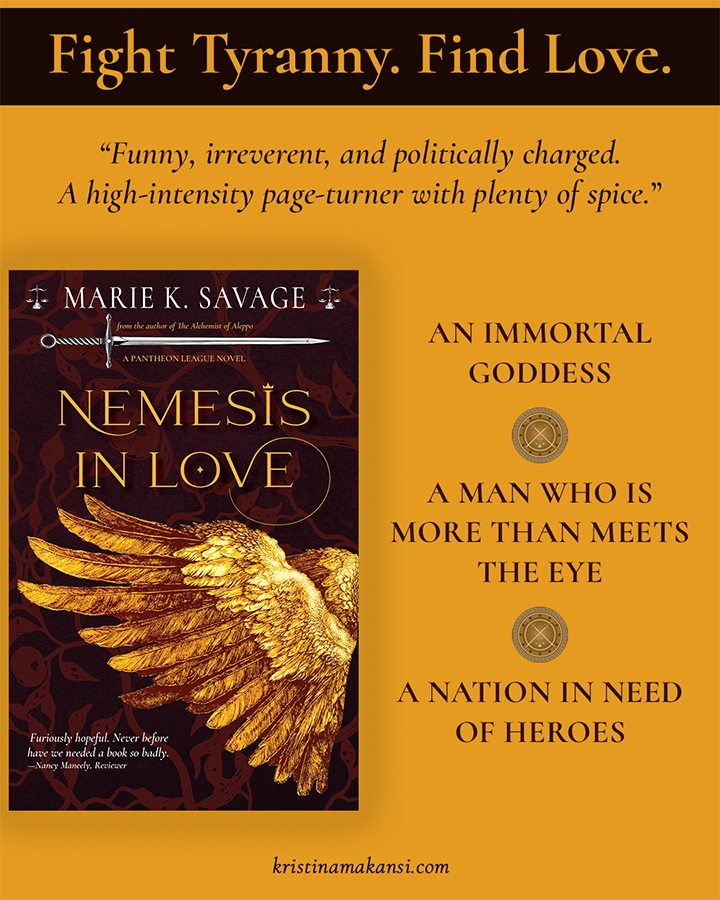
About Nemesis in Love, Book One of the Pantheon League Series
For the characters in The Pantheon League series, the near-future New America is not too close to home, it is home. And the characters must choose whether to go along to get along or to stand up, speak out, and risk everything.
Of course, my heroes and heroines choose to stand up against the tyranny of the greedy, power-hungry few, and I am happy to be able to give them the pages on which to do it.
There are times in our lives when it no longer does much good to dance around the harsh realities confronting society, like emerging fascism, ecological destruction, and rapid deterioration of the current geopolitical order. Too many of our politicians, journalists, media figures, and civic leaders are acting like it is business as usual in America.
Some say, Let our senators and representatives take care of it because that’s what they’re there for. Really? You think that’s going to work?
Or they say, Let's just vote them all out of office! Yeah, right. You seriously think that’s going to work when the very people in charge are trying to undermine the voting system and the president still insists he won in 2020 and randomly claims that every election in which his party loses is rigged.
We all need to recognize that today the monster in the narrative is our own government, and the powerful elite of our own nation are the bad guys. And we need to say it loud and clear because apparently metaphors are no longer enough.
Please sign up for our newsletter for more information on all our artistic endeavors.