by Jason Makansi (originally posted on Substack)
One reason I love absurdist fiction and theatre is because the very act of communication is often called into question. And the passage in the photo below, from the play, The Bald Soprano, by Eugene Ionesco, is in my mind the asymptotic limit of language, the point at which words no longer have meaning. The other page photographed explains what is going on in this play.
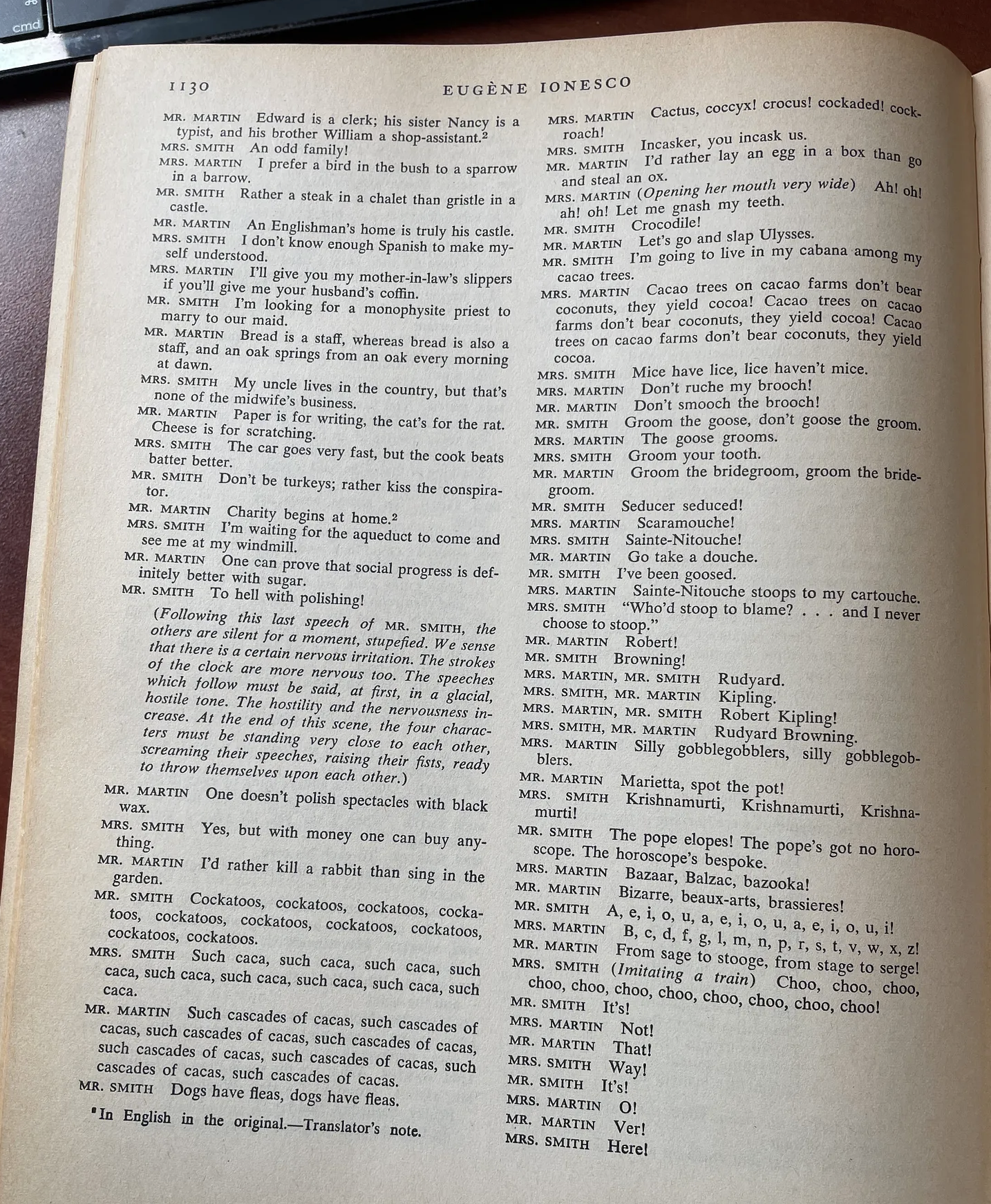
A page from The Bald Soprano
I read this play in college in a course called Modern Drama I (I also took the sequel, Modern Drama II). The passages come from the text for the course, Masters of Modern Drama. (And I do wish I could find the person who borrowed my textbook for the same course two years later and returned it with a broken spine and other problems—since then, and because of books loaned and were never returned, I am extremely careful who I let walk out of my library with one of my books).
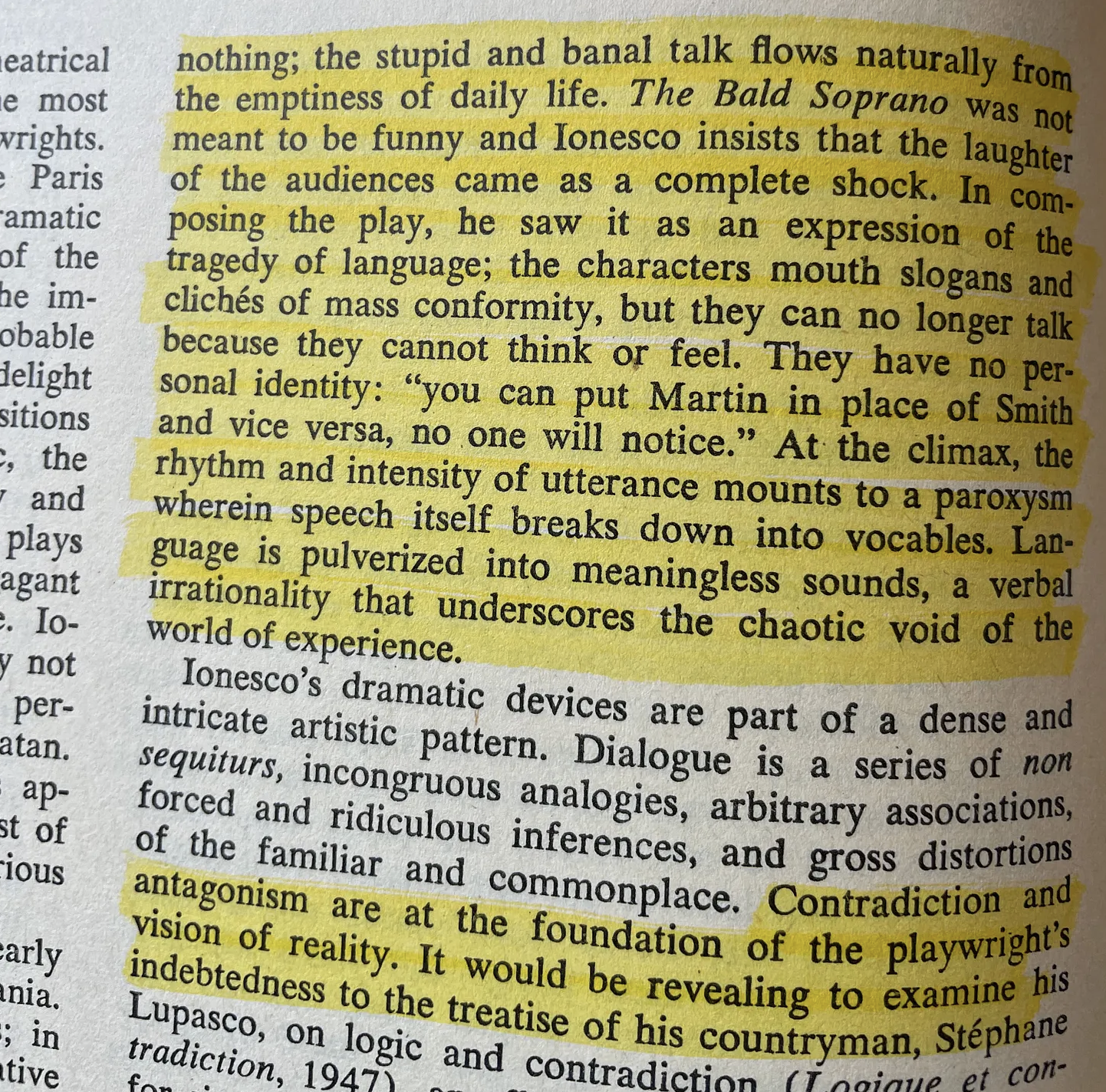
Thoughts on Ionesco’s dramatic use of language.
It's strange how a passage like this can stay with you throughout your life. But this one from The Bald Soprano has definitely impacted me, from a variety of different perspectives. Sometimes when I retract from a social conversation, I will notice that actual communication isn’t much different from what is portrayed here. In the course of a 40-year “successful” marriage (like mine), I’ve often wondered, are we really communicating here? My spouse undoubtedly thinks the same.
At some point in my life, maybe in high school (?), I repeated a word over and over and mentally, implicitly, understood how a word could dissociate from its meaning, but didn’t think much about it at the time. Try it! It’s really weird. Much later, I learned that there’s a phrase for that dissociation, semantic satiation. Ionesco not only captures semantic satiation (towards the end of the page in the photogragh), but the breakdown of words into “vocables,” vocalized syllables of the word.
What all this impressed upon me was the fragility of language, and you have to be hyper self-aware of that fragility to “get it.” On top of that, not only are there thousands of languages and dialects, but to truly understand someone else, you have to truly be listening to them. And aware of the fragility of language and the tenuousness of words and sentences and what is said—and as importantly not said.
I would not have described myself as “political” until I married a political science major and the MacNeil Lehrer Report replaced the M.A.S.H., Saturday Night Live, and I Love Lucy reruns, and New York Yankee baseball, I used watch after work. After Bush II invaded Iraq, I became a political junkie and not only became obsessed with the news but with deeply analytical books and documentaries about politics and culture (and corruption and hypocrisy). My entire adult life, I prided myself on being informed from all sides of the opinion spectrum.
My first novel, The Moment Before, grappled with how geopolitics in the Middle East affects the lives of American Arabs here at home. So do many of my short stories, of which I’ve managed to get about a dozen published over the years.
In these times, beginning with Trump I, all that motivation to be broadly informed began to dissipate. After Trump II began, I quit. I’ve given up almost all of it. I’ll scan headlines but anything deeper, frankly, seems no better than Ionesco’s dialogue, at least from the perspective of fully informing oneself. You say potato, I say tomato.
All that makes sense these days is absurdist fiction, the absurdist playwrights, and satire.
Some readers escape into dystopia, fantasy, science-fiction, and romance. I escape into absurdism and satire. And I’m getting ready to publish a new novel of what I call “brutalist satire,” Wrequiem at the Red Rocks, for which the tag line is “Freedom is controlling the narrative.” At it’s core, Wrequiem is a satiric takedown of American exceptionalism in its many mythical incarnations and incantations.
Now, I know that everything you read, every television show, every film, every social media post is an attempt by an individual, group, institution, or government to validate or alter your perception of something.
Ultimately, in the fifty-one years since I read The Bald Soprano, I have come to understand that the purpose of language, the purpose of communication, the purpose of education, the purpose of art, and even the purpose of knowledge itself is, simply, to control the narrative.
And if you have the freedom and the power to control the narrative, you have the power to control everything.
Please sign up for our newsletterfor more information on WREQUIEM AT THE RED ROCKS by Jason Makansi.