WREQUIEM AT THE RED ROCKS: SATIRE AND ABSURDISM IN TODAY’S AMERICA
by Jason Makansi
I’m a sucker for books in a series designed to all look alike. Maybe that’s because I used to read the World Book Encyclopedia when I was really young. Today, I still admire my McGraw-Hill Chemical Engineering textbooks from college whenever I pass them on my library shelves, those stalwart steely gray and forest green colors on the spines, colors which scream I’ll last forever! (or until I die and my kids say, who needs this shit?).
So when I was manning a booth at a publishing exhibition a few years ago and had time to stroll the expo hall on the last day (when exhibitors are desperate not to ship books home), I bought three heavily discounted books in Oxford University Press’ Reader for Writers series (instructor’s editions)—one on sustainability, one on humor, and I can’t find the third.
After I completed a draft of my new satirical novel, Wrequiem at the Red Rocks, I thought, maybe I should take a look at that book on humor. Well, it turns out that reading analytical material about humor is about as painful as a joke that has to be explained after it’s told. Maybe worse.
Here are two definitions of satire: (1) A literary work holding up human vices and follies to ridicule and scorn, and (2) trenchant wit, irony, or sarcasm used to expose or discredit vice or folly (Webster’s New Collegiate Dictionary, 1977).
Maybe sardonic is the better word, “showing disrespect or scorn for someone or something: disdainfully or skeptically humorous: derisively mocking” (same dictionary). Well, no one ever uses the phrase “sardonic novel,” so I went with satirical.
When I decided to write Wrequiem, I wasn’t necessarily thinking about satire, per se. I was really thinking of a book like the three funniest novels I’ve ever read—Catch-22, A Confederacy of Dunces, and The Sellout. These three novels are laugh-out-loud funny. You don’t want to read them adjacent to someone you love with liquid in your mouth. Lots of novels have funny segments, witty and sarcastic characters, “trenchant irony,” and a few scenes that might qualify for the description on the back cover, “hilarious romp.”
These three are hilarious from beginning to end. I could also add Music for Torching by A.M.Homes, but this novel isn’t as universally considered a member of the satiric canon. In fact, of all the people I know who read it, most on my recommendation, I am the only one who thinks it does belong there.
These novels are not just funny. They make you uncomfortable as you laugh. Like, should I really be laughing this hard at this scene, or laughing at all? They make you examine the human condition. Most importantly, they pick at the scabs of your own prejudices, privileges, cruelties, and subliminal thought processes. They make you question what you think you know about the world around you.
The Sellout in particular forced this liberal, white (in the eyes of the US Census anyway) reader to face, sequentially, nine dimensions of hell regarding my own ideas, perceptions, education, and biases regarding African Americans, how they are portrayed, and how they view and interact with each other. When a novel opens with African Americans owning slaves on their own isolated plantation in greater contemporary Los Angeles…I mean, what can you do but a spittake and keep reading? I could read The 1619 Project word for word and not come away with a better appreciation of the complexities of the African American experience in the 21st Century.
Another element I worked hard to make part of Wrequiem, no less important, is aburdism, or “the state or condition in which man exists in an irrational and meaningless universe, and in which man’s life has no meaning outside his own existence” (same dictionary).
While I admire my chemical engineering textbooks, chemical engineering had little admiration for me. I was a middling engineering student at best, wanting the degree so I’d be very employable. The courses I really loved (and seriously brought up my grade point average) were ones like Modern Drama I and II outside of the engineering school, where I first became acquainted with the works of playwrights in the vanguard of the Theatre of the Absurd.
To this day, absurdism describes the world around me in a more meaningful—more truthful—way than chemical engineering ever did.
Wrequiem at the Red Rocks takes place in Sedona, Arizona, at the “Neo-anthropocentric Models and Retrospective Freedoms” colloquium, sponsored by the Center for the Study of the Philosophy of Freedom,” an academic think tank funded by a billionaire misogynist tech bro. It’s about the studious examination of vague, ambiguous concepts like freedom, which no one can define; researchers quantifying things that shouldn’t (or can’t truly) be quantified; personal grievances mucking up professional conduct; too much money being spent in all the wrong places; professors struggling to sustain their own brands; and manipulation by the thin slice of those in power who are pulling all the strings anyway.
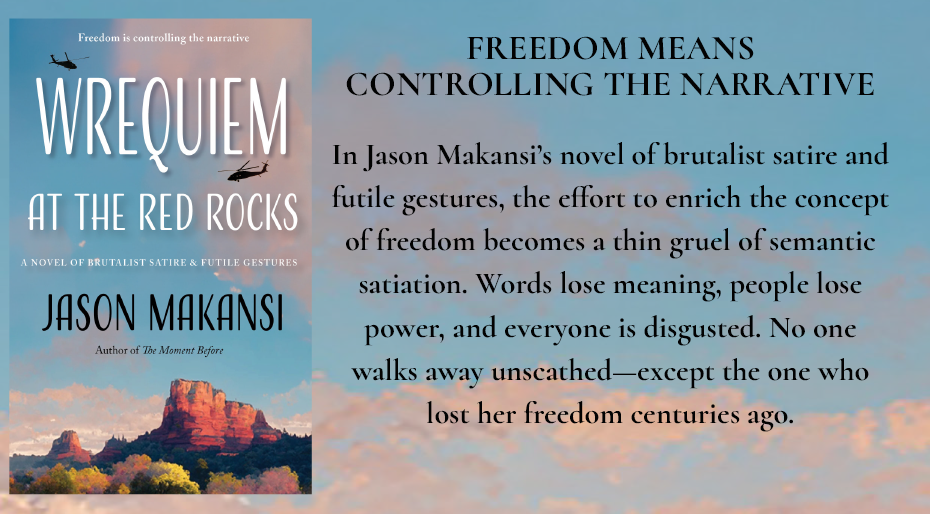
Cover and brief description of WREQUIEM AT THE RED ROCKS by Jason Makansi. Coming May 19, 2026.
It's also a buddy story. Two aging “okay, boomer-type” white guys (one much whiter than the other) lifelong friends since college, text back and forth during the conference. One, the protagonist and conference facilitator, is coming to terms, ever so slowly, with his past behavior in light of current cultural movements (playing out loudly and in full view at the conference). The other just wants to know how many girls his friend has slept with.
The very discussion of freedom begins to affect the tone of the colloquium as panelists and attendees, and the protagonist, speak their minds and reveal things better left unsaid. As speakers tackle crime, education, social media participation, free will, even the freedom to “think,” etc., they get tangled up in the shorts of their own academic jargon in scenes reminiscent of the absurdist playwrights.
So I suppose while I am satirizing the academic conference in Wrequiem, the overall thesis is absurdist, i.e., America in the Twenty-First Century is an irrational mess, driven by extreme capitalist policy, overt invasions of sovereign nations, regression to racist and classist ideologies, retreat from global treaties and obligations, reversal of all policies addressing climate disruption, extreme personal and professional branding, etc. We enslave the world through dollar hegemony, military and technological superiority, resource confiscation, and ecological devastation while pretending we can beat China at the long game. And preening on the world stage as if we’re the best thing that ever happened in the world.
Today, our leaders no longer even bother to pretend that America is an honest broker on the world stage or that we aspire to a just and equitable society. We never were that beacon on the hill, but now the bulbs have burned out, the electricity cut off, and the lighthouse keeper has been fired. And still we preen.
The absurdist playwrights rose to prominence in the shadow of two World Wars, the emerging Cold War, and rising authoritarian regimes across Eastern and Central Europe. Wrequiem was written while the second coming of Trump tramples this nation’s norms, principles, and supposed ideals right along with running roughshod over the rest of the world, like King Kong stomping through the jungle.
As Oliver Kornetzke wrote in perhaps the most accurate depiction of Trumpism, “it is America’s shadow made flesh—a rotting idol proving that when a nation kneels before money, power, and spite, it doesn’t lose its soul quietly, it vomits up this bloated obscenity and dares to call it a leader … Not a president. Not even a man. Just the diseased distillation of everything this country swears it isn’t but always has been. Arrogance masquerading as exceptionalism, stupidity passed off as common sense, cruelty sold as toughness, greed exalted as ambition, and corruption worshipped as gospel.”
Kornetzke captures how I often feel—the America I exist in has become irrational and inexplicable, but also, perhaps not surprisingly, has reached the asymptotic limit of the trajectory we’ve been on all along. Survival and thriving as individual capitalists with no social safety nets means controlling our own narratives out there in physical and cyberspace. We’re all victims of the nine dimensions of hell. All happy Americans are the same; all unhappy Americans are unhappy in their own way—and fully exposed through every media screen available.
Meanwhile, we persist in conducting our lives, aware of what’s happening but powerless to do much about it. Life isn’t really like the Lord of the Rings trilogy (which I watched again with my family over the holidays, because I slept through them the first time around). Wrequiem is meant to be about hyper-reality, not fantasy. There are no winners in Wrequiem. But there are survivors. One is a Native American woman quietly going about the business of bleeding the invaders dry until they give up and find somewhere else to ravage. In her quiet observations, she just might be the only sane character in the whole motley bunch.
There is no “resolution” to the story. What’s left at the end are the contradictions and hypocrisies we struggle to ignore and move on from. The final reveal lays bare everything we are but swear we aren’t.
Happily, as I discovered from the academic literature (specifically, in an essay by Felix Clay in the humor book referenced above), Wequiem also includes at least one of each of the “six weirdly specific characters that are in every sitcom ever.” These are: “The horny character, the crabby old fart, the servant, the idiot, the fish out of water, and the straight man.”
Hopefully after reading Wrequiem, you will come away with a better appreciation of the complexity of the American experience in the 21st Century, regardless of where in the overlap of Venn Diagram circles of ethnicity, religion, education, affluence, and gender fluidity you see yourself.
Oh, did I mention that a straight, white guy who can’t stop masturbating is date-raped? Kind of ironic, like those Black slave-owning, plantation dwellers in LA.
I dream of a day when Wrequiem is issued as a collection with similar books designed with similar “this is a classic, damnit!” covers and impressive spines, resting comfortably on bookshelves worldwide with my other favorite satirical novels. After all, as I’ve learned on Instagram, I have to manifest my own success.
Also, please sign up for our newsletter for more information on WREQUIEM AT THE RED ROCKS. And another non-fiction book coming soon from Jason as well. In the vein of his award-winning PAINTING BY NUMBERS, he’s working on a book on knowledge—what we know, what we think we know, how we know it, and why it all matters.
As always, stay tuned for more!